
On this page
- When should Portland gutters be cleaned?
- Why does timing matter so much here?
- What does a proper clean include?
- What about moss?
- Is cleaning gutters yourself safe?
- What can reduce how often you clean?
- What should a cleaning quote say?
- What do local trees drop, and when?
- What happens if debris is left in the gutter?
- What does a cleaning visit cost?
- What should you do between cleanings?
- How do you choose who cleans your gutters?
- What does a clean reveal?
When should Portland gutters be cleaned?
Around the trees and the rain. Call
to have a contractor clean your gutters, or use the schedule below to plan your own.| Situation | Cleanings a year | When |
|---|---|---|
| Few trees nearby | 1 to 2 | Late autumn; spring if needed |
| Typical yard and street trees | 2 | Late autumn and late spring |
| Tall firs, cedars or hemlocks overhead | 3 | Late autumn, mid-winter, late spring |
| Big maples overhead | 2 to 3 | Late autumn, late spring after seeds |
| Heavy moss on the roof | Add roof clearing | Late spring or early autumn when dry |
| With metal micro-mesh guards | Brush 1 to 2 | Spring and autumn |
Why does timing matter so much here?
Because the debris and the wettest weeks arrive together. At the airport, the wettest months are December, November and January, each averaging more than five inches, and leaves and needles come down from October. A gutter half full of wet debris at the start of a long November rain will overflow, sag and soak the fascia. A clean in late November or early December prevents most of that. The spring clean clears winter debris, seeds and catkins before they bake into a mat over summer.
What does a proper clean include?
| Step | Why |
|---|---|
| Remove debris from every run by hand or scoop | Wet mats hold water against the metal |
| Clear each outlet and the top of each downspout | Most overflow starts there |
| Flush each downspout | Needles and seeds jam at elbows |
| Watch the flush water | Standing water shows lost pitch |
| Check corners, end caps and seams | Drips show failing sealant |
| Check hangers and the fascia | Loose fasteners and soft wood show up |
| Clear valleys and the roof edge above | The next rain washes them into the gutter |
| Check where downspouts discharge | Extensions get knocked aside |
| Bag and remove debris | Not left on beds and lawns |
What about moss?
Moss on a roof sheds into the gutter every time it rains. OSU Extension says moss traps soil and debris and holds moisture, and it can lift shingles and let water reach the layers below. Clearing the gutter without dealing with the roof edge means it refills quickly. Many cleaners will sweep loose moss from the lower roof and valleys; heavier moss removal is a roofing job. Avoid pressure washing roofs, which can damage shingles. See moss and gutters.
Is cleaning gutters yourself safe?
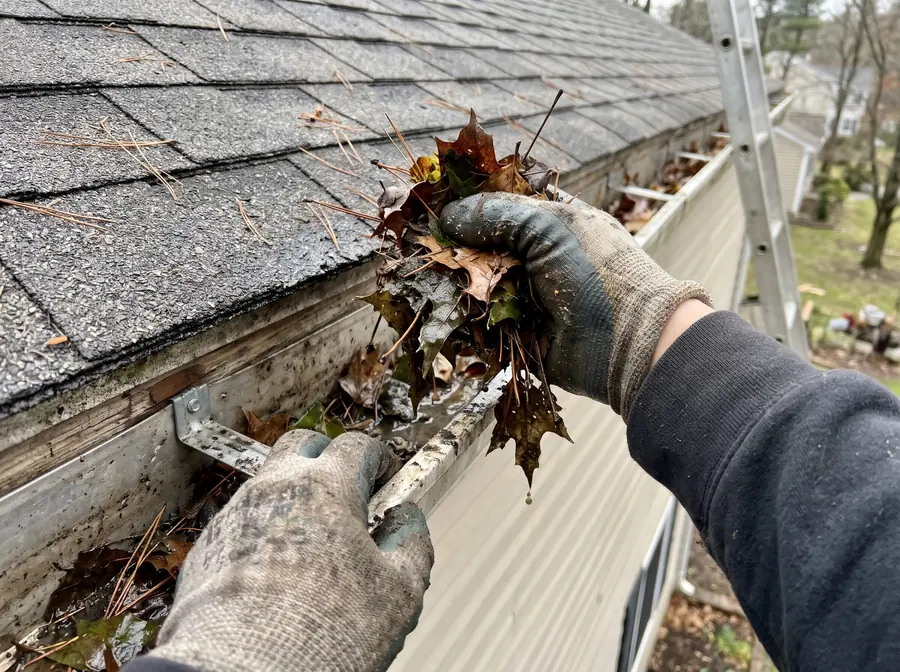
On a single-storey house with a sturdy ladder, firm level ground and dry conditions, many people do. Wet, mossy roofs and steep pitches are slippery, and second storeys are where falls happen. Use a ladder stand-off so the ladder does not rest on the gutter, keep three points of contact, wear gloves and stay off the roof in wet weather. If you would rather not, a contractor can do it.
What can reduce how often you clean?
Trimming branches back from the roof where rules allow, adding outlets on long runs, using 3x4 downspouts that pass needles, and fitting metal micro-mesh guards. Portland requires a permit to prune any street tree, except for very small branches, and street trees are the responsibility of the adjacent property owner to maintain under city rules. On private property, no permit is needed for most pruning, including branches within 10 feet of a building, though rules differ in environmental overlay zones.
What should a cleaning quote say?
Whether downspouts are flushed, whether the roof edge and valleys are included, how debris is disposed of, and whether you will get a short note on repairs needed. Ask about a price for a second visit later in the season if you are under heavy trees.
What do local trees drop, and when?
| Tree | What falls | Peak timing |
|---|---|---|
| Douglas fir | Needles, cones, twigs | Year-round, heavier in wind and ice |
| Western red cedar | Fronds and scale-like needles | Autumn and winter |
| Bigleaf maple | Large leaves, winged seeds | Leaves in autumn; seeds in late spring and summer |
| Norway maple | Leaves, winged seeds | Leaves in autumn; seeds in summer |
| Oaks | Leaves, acorns, catkins | Autumn; catkins in spring |
| Birch and alder | Catkins, small leaves, seeds | Spring and autumn |
What happens if debris is left in the gutter?
It turns into a heavy, wet compost that holds water against the metal for months. Hangers pull loose under the weight, outlets block, water spills over the front onto beds and paths or runs behind the gutter onto the fascia, and seedlings and moss start growing in the trough. On steel gutters, wet debris speeds rust. Leaving a gutter full through one winter often turns a cleaning into a repair.
What does a cleaning visit cost?
Prices vary with storeys, length, roof type, how much debris there is and whether downspouts are flushed and the roof edge cleared. Ask for a written price that lists what is included. Under heavy trees, ask about a second visit price for later in the season.
What should you do between cleanings?
After windstorms and ice, look along the gutter line from the ground for branches, bent runs or lifted guards. In a long rain, check that each downspout is flowing. If one is spilling over at the top, note it and clear it once it is safe, or call a contractor.
How do you choose who cleans your gutters?
For cleaning only, Oregon's CCB lists gutter cleaning as work that does not need a license, though many cleaners are licensed contractors who also repair and install. Ask what is included, whether they flush downspouts and clear the roof edge, how they protect the roof and plants, and whether they will tell you about repairs needed. If repairs are done on the same visit, the person doing them should have a CCB license.
What does a clean reveal?
A good clean is also an inspection. Loose hangers, leaking corners, soft fascia, standing water and bent runs all show up when the gutter is empty. Ask for a short note or photos so you can plan repairs in the dry season.