
On this page
- When is it time to replace gutters?
- What does replacement involve?
- Why is fascia so often part of the job?
- Where should the new downspouts drain?
- What should the new system be?
- What drives the cost?
- What should you check before signing?
- How do you compare replacement quotes?
- What happens to the old gutters?
- Will new gutters change how the house looks?
- What should a replacement day look like?
- How long should new gutters last?
- Should you replace gutters before selling a house?
- Can you replace gutters in stages?
When is it time to replace gutters?
When repairs are treating symptoms on a system that is wearing out. Call
and a contractor can price both repair and replacement so you can compare.| Sign | What it means |
|---|---|
| Leaks at several corners and seams | Sealant and joints failing across the system |
| Sags returning after re-hanging | Fascia too soft to hold fasteners |
| Rust holes along steel troughs | Metal corroded by years of wet debris |
| Cracked or warped vinyl | Material at the end of its life |
| Gutters pulling away along whole runs | Fastening and wood both failing |
| Thin, dented .027 aluminum | Will not hold its line or survive ice |
| Water staining or rot behind most runs | Water has been getting behind the gutter |
What does replacement involve?
- Removing old gutters, hangers and downspouts.
- Inspecting fascia, rafter tails and the roof edge.
- Repairing or replacing soft wood.
- Checking the drip edge laps into the back of the new gutter.
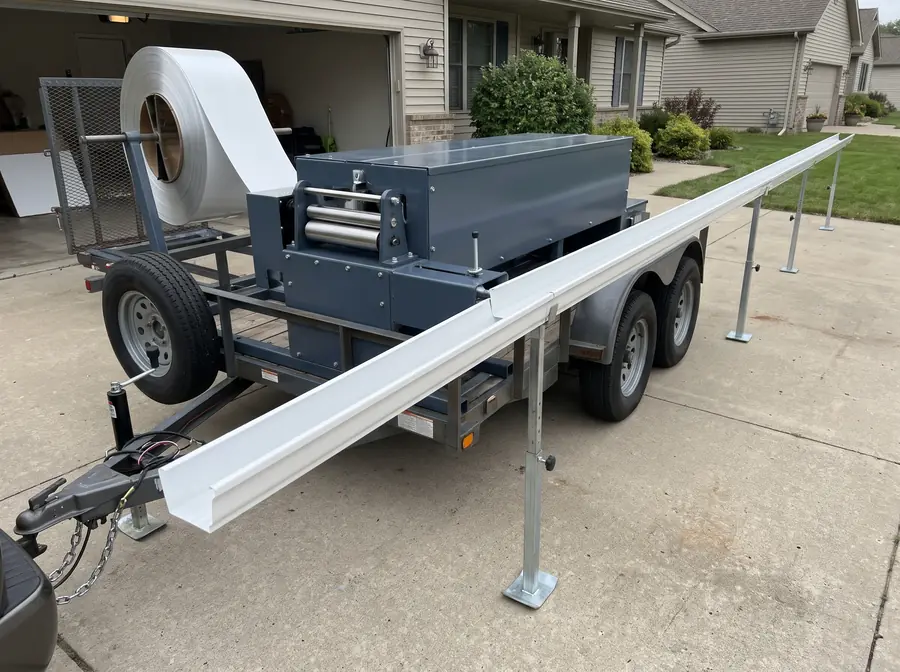
- Forming seamless runs on site to measured lengths.
- Hanging on hidden hangers pitched to each outlet.
- Sealing and riveting corners and end caps.
- Fitting downspouts and deciding where each drains.
- Testing with water and cleaning up.
Why is fascia so often part of the job?
Because water that has been getting behind a gutter for years has usually reached the wood. In a climate with measurable rain on around 157 days a year, boards that stay damp under a debris-filled gutter soften and rot. Fasteners cannot hold in soft wood, so the new gutter would fail the same way. Fascia repair is usually priced once the old gutters are down and the wood can be seen. See fascia and soffit repair.
Where should the new downspouts drain?
Replacement is the right moment to decide. Many older Portland homes have downspouts piped into standpipes leading to the combined sewer; between the 1990s and 2011 the city disconnected about 56,000. If you are considering disconnection, the city's rules set minimum distances from basements, crawl spaces, property lines, sidewalks and retaining walls, and say not to disconnect on slopes over 10 percent. On lots where disconnection is not safe, keeping the existing connection may be the right answer. See downspout disconnection in Portland.
What should the new system be?
| House | Usual choice |
|---|---|
| Postwar ranch | Seamless .032 aluminum, 5-inch, more outlets |
| Two-storey with valleys | 5-inch with 6-inch below valleys, 3x4 downspouts |
| House under tall firs | 6-inch with metal micro-mesh |
| Period home in a historic district | Half-round or copper; check district rules |
| Hillside home | Secure hangers, downspouts carried to a safe outlet |
What drives the cost?
Length, storeys, corners, material, thickness, downspout count, fascia repair, roof type and access. National guides put seamless aluminum at about $9 to $14 a foot for 5-inch and $11 to $17 for 6-inch, before fascia and extras. See the cost guide.
What should you check before signing?
The contractor's CCB license, a written contract for jobs over $2,000 with the CCB's three required notices, what is included for fascia and disposal, the warranty, and the payment schedule.
How do you compare replacement quotes?
Put them side by side and check that they describe the same job. Look at gutter size for each run, metal and thickness, hanger type and spacing, number and size of downspouts, where each downspout drains, how fascia repair is priced, removal and disposal, color, warranty terms and payment schedule. A lower total that leaves out fascia, uses .027 metal or spaces hangers widely is not really cheaper.
| Item | Quote A | Quote B |
|---|---|---|
| Size and profile per run | ||
| Metal and thickness | ||
| Hangers and spacing | ||
| Downspouts: number, size, discharge | ||
| Fascia repair | ||
| Removal and disposal | ||
| Warranty | ||
| CCB number |
What happens to the old gutters?
Aluminum, steel and copper are all recyclable, and many contractors take old metal to a recycler. Ask whether removal and disposal are included in the price.
Will new gutters change how the house looks?
They can improve it. Seamless runs have fewer visible joints, hidden hangers leave a cleaner line, and a well-chosen color can make gutters disappear against the trim. On period homes, half-round or copper can restore an original look.
What should a replacement day look like?
The crew protects plants and walkways, takes down the old gutters and hangers, inspects and repairs fascia, forms new runs on site, hangs them pitched to each outlet, seals and rivets corners, fits downspouts and extensions, and water-tests every run. Ask for metal shavings to be cleaned off the roof and for old gutters to be hauled away.
How long should new gutters last?
Well-hung seamless .032 aluminum on sound fascia, kept reasonably clean, lasts many decades. Steel lasts well while its coating is intact. Copper lasts longest. In practice, fastening, fascia and upkeep decide the life of a system more than the metal does.
Should you replace gutters before selling a house?
If they are leaking, sagging or rotting the fascia, buyers and inspectors will notice. A replacement with clear paperwork, a CCB-licensed contractor and a written warranty can help. If the gutters are sound, a clean and minor repairs may be enough.
Can you replace gutters in stages?
Yes. Many owners replace the worst side first, often the one under the trees or facing the weather, and the rest later. Ask the contractor to keep profile, size and color consistent so the house looks right when finished.