
On this page
What gutter repairs are common in Portland?
The ones caused by wet weight and a long rainy season. Call
and a contractor can look at the problem and tell you whether it needs a repair or a new run.| Problem | Usual cause here | Usual fix |
|---|---|---|
| Leaking corners and seams | Aged sealant, joints flexing under wet weight | Strip, clean, reseal and rivet |
| Sagging gutters | Spikes pulling out, soft fascia, wet needles | Hidden hangers into sound wood |
| Overflow | Blocked outlets, valleys, lost pitch | Clear, add outlets, re-pitch, wider sections |
| Ice and storm damage | Freezing rain, falling limbs | Replace bent runs, re-hang, new downspouts |
| Downspout problems | Jammed elbows, crushed sections, bad discharge | Clear, replace, upsize, re-route |
| Fascia and soffit rot | Years of water behind the gutter | Replace boards, then re-hang |
Water spills over the gutter in a long autumn rain
Portland's rain is steady rather than violent, so a spilling gutter is usually blocked, not undersized. Fir needles, maple seeds and leaves collect at the outlets in October and November, just as the wettest months begin. Clear the outlet and downspout first. If a clean gutter still spills, the run may have lost its pitch or a valley is pouring into one spot. See gutter overflow.
Green sludge and moss are building up in the trough
Moss on a shaded roof sheds into the gutter every time it rains, along with the grit it traps. It packs into a wet mat that holds water against the metal and the fascia. Cleaning the roof edge and the gutter together, and letting more light reach the roof, helps more than cleaning the gutter alone. See moss and gutters.
The gutter sags or has pulled away from the fascia
Wet needles and moss add weight for months at a time, and old spike-and-ferrule fasteners work loose as the wood swells. If the fascia behind is soft, nothing will hold until the board is replaced. Re-hanging on screw-in hidden hangers usually fixes the rest. See sagging gutters.
Ice or a falling limb bent or tore the gutter
Ice storms in February 2021 and January 2024 brought down limbs and whole trees across the Portland area. A bent run, crushed downspout or gutter hanging off the house needs attention before the next storm. Photograph it first if you plan an insurance claim. See storm damage.
Water pools by the foundation or soaks the basement wall
Look at where the downspouts end. If a downspout drops into a pipe in the ground, it may run to the sewer or an old drywell. If it ends at the wall, the water stays there. The City of Portland's disconnection rules call for discharge at least 6 feet from a basement and 2 feet from a crawl space. See downspout disconnection.
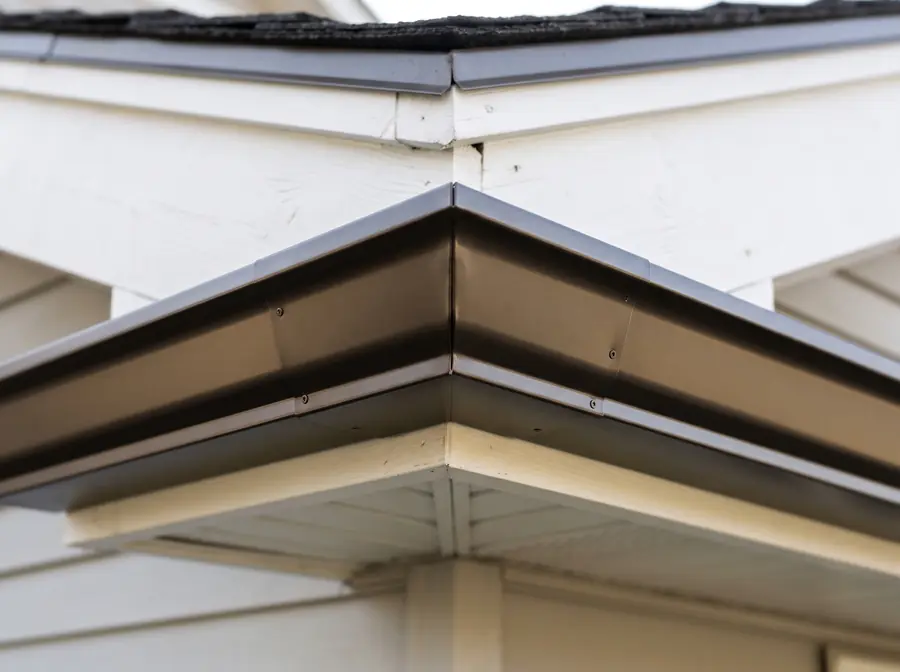
A corner or seam drips even when the gutter is clean
Corners and end caps are sealed joints, and sealant ages with years of wet winters and the odd heat wave. The fix is to strip the old sealant, clean the metal and reseal, adding rivets where the joint relies on sealant alone. See leaking gutters.
Why do gutters fail faster in a wet climate?
Because they rarely get a chance to dry. Portland gets measurable rain on around 157 days a year, and the wettest months, December, November and January, follow straight after leaf and needle fall. A mat of debris in the bottom of a gutter holds water against the metal, the sealant and the fascia for weeks. OSU Extension notes that moss traps soil and debris and holds moisture, and some of that ends up in the gutter with every rain. The result is corroded steel, softened sealant, rotted wood behind the hangers and a gutter that sags under its own wet load.
How does ice change the picture?
Ice storms are infrequent but hard on gutters. During the February 2021 storm, PGE reported that an inch of ice added 1,000 pounds to each span of power line, and the same ice coated trees, roofs and gutters. Gutters that were already loose or full of debris were pulled from the fascia; limbs bent runs and crushed downspouts. In January 2024, another storm brought numerous downed trees across the city. After any freezing rain, look along each run from the ground for kinks, gaps at the fascia and downspouts knocked off their brackets.
When is repair the right call?
| Situation | Repair | Replace |
|---|---|---|
| One or two leaking corners, sound metal | Yes | |
| A sag on one run, solid fascia | Yes | |
| One run bent by a limb | Replace that run | |
| Leaks at many sectional seams | Short term | Yes |
| Rust holes in steel along the trough | Yes | |
| Soft fascia along most of the house | Yes, with fascia repair | |
| Thin, dented .027 aluminum throughout | Yes |
See repair or replace for more.
What does a good repair look like?
A repair that fixes the cause. A corner should be cleaned to bare metal before resealing, and riveted. A sag should be re-hung on screw-in hangers into sound wood, not re-spiked into old holes. A downspout that keeps clogging may need a larger size or an extra outlet. A gutter that overflows at a valley may need a wider section. Ask the contractor what caused the problem and what they will do so it does not come back.
What about downspouts that go underground?
Many older Portland homes have downspouts that drop into standpipes connected to the sewer or old drywells. If a downspout backs up, the blockage may be in the pipe, not the gutter. A contractor can check whether disconnection is possible under the city's setback rules, or whether the underground line needs clearing by a plumber. See downspout repair.
What can you check from the ground?
Quite a lot. Walk around the house during a steady rain with a raincoat on. Water spilling over the front of the gutter points to a blockage or a valley; water dripping behind the gutter points to a gap at the fascia or a missing drip edge; a steady drip at a corner points to failed sealant. Look along each run for dips, gaps between gutter and fascia, and downspouts that have come loose. Note where water pools near the foundation. Photos of each give the contractor a head start.