
On this page
- How do the cheaper guard types compare?
- Why do needles beat most guards?
- When do screens and covers make sense?
- How do you tell which guard you have?
- Should you remove an old guard that is not working?
- What do these guards cost compared with micro-mesh?
- How should any guard be fastened?
- Do guards affect roof moss?
- What should you do with an old guard that keeps clogging?
How do the cheaper guard types compare?
Call
to talk to a contractor about which guard suits your trees.| Type | How it works | Under Portland trees |
|---|---|---|
| Screen | Wire or plastic grid over the gutter | Needles and seeds pass or lodge |
| Perforated aluminum cover | Sheet with small holes | Big leaves stay out; needles slip through |
| Reverse-curve | Hood that curves water into a slot | Leaves stay out; needles and moss bridge the slot |
| Foam insert | Foam block filling the trough | Holds water, grows moss and seedlings |
| Brush insert | Bristles along the trough | Needles tangle in bristles |
Why do needles beat most guards?
Because they are long, thin and arrive in huge numbers. Douglas fir is native here, and many Portland lots have conifers overhead. Needles slide through screen grids and perforated holes, stack on top of foam and tangle in brushes. Fine moss sediment, which OSU Extension says moss traps and holds on the roof, washes through screens and coats inserts. That is why fine metal mesh outperforms these types here.
When do screens and covers make sense?
- Big deciduous leaves only. Where oaks or large maples are the main problem and conifers are not overhead.
- Budget, single-storey homes. Where you will still clean occasionally.
- Temporary fixes. Until a full replacement with micro-mesh.
How do you tell which guard you have?
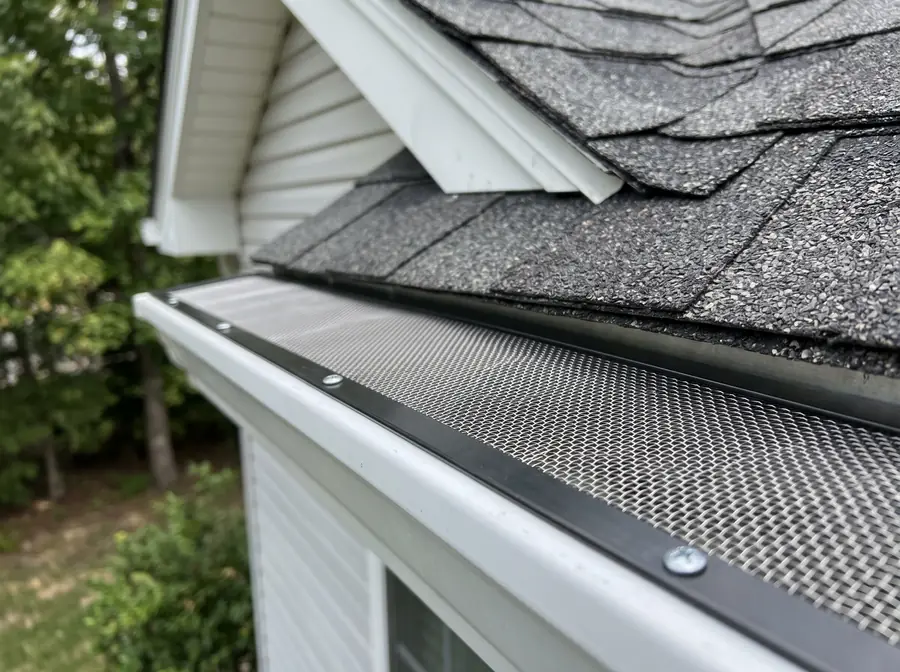
From a ladder or upstairs window. A fine metal fabric on a frame is micro-mesh. A sheet with rows of small holes is a perforated cover. A grid you could push a pencil through is a screen. A smooth hood curving over the front with a narrow gap beneath is reverse-curve. Foam or bristles inside the trough are inserts.
| Problem | Likely cause | What to do |
|---|---|---|
| Water sheets over the guard | Debris matted on top, or overshoot | Clean; consider micro-mesh |
| Gutter full underneath | Needles and seeds passed through | Remove, clean, refit or replace |
| Screen sagging into trough | Weight of wet debris | Replace with a rigid metal frame |
| Guard lifted or missing | Clipped, not screwed; wind or ice | Refit with screws to the lip |
| Moss or seedlings in foam | Wet foam grows plants | Remove the foam |
Should you remove an old guard that is not working?
At least to clean underneath. Then refit it, replace it with micro-mesh, or go without. See micro-mesh gutter guards.
What do these guards cost compared with micro-mesh?
Screens and foam are the cheapest to buy, perforated covers sit in the middle, and reverse-curve and micro-mesh cost the most. Over time, cheap guards that need frequent cleaning or replacement can cost more. Under Portland's conifers, a guard that lets needles through saves little cleaning at all.
| Guard | Upfront | Upkeep under conifers |
|---|---|---|
| Foam insert | Lowest | High; replace often |
| Plastic screen | Low | High |
| Metal screen | Low to moderate | Moderate to high |
| Perforated aluminum | Moderate | Moderate |
| Reverse-curve | Higher | Moderate; slot clogs |
| Micro-mesh | Higher | Low |
How should any guard be fastened?
Screwed to the front lip of the gutter so it cannot lift in wind or when ice slides off the roof. Clip-on and slide-in guards are the first to come loose in storms. Guards should also leave the drip edge working so water lands in the gutter, not behind it.
Do guards affect roof moss?
No. Guards sit on the gutter. Moss grows on the roof, mostly where it is shaded and stays damp. OSU Extension's advice is that letting more sun reach the roof is what keeps moss down. See moss and gutters.
What should you do with an old guard that keeps clogging?
Take it off, clean the gutter underneath, check the gutter is sound and pitched, then decide whether to refit it, replace it with micro-mesh or go without. Under conifers, a guard that lets needles through often costs more in cleaning than it saves.