
On this page
- What size downspout do you need?
- How many downspouts does a house need?
- Where should downspouts drain in Portland?
- What if disconnection is not safe?
- How are downspouts fastened?
- Can a downspout feed a rain barrel?
- What goes wrong with downspouts?
- How should a downspout be routed on a hillside lot?
- What about downspouts near driveways and paths?
- What does a downspout cost?
What size downspout do you need?
| Downspout | Roof served (national guidance) | Best for |
|---|---|---|
| 2x3 rectangular | about 600 sq ft | Small roofs, few trees |
| 3x4 rectangular | about 1,200 sq ft | Larger planes, valleys, trees overhead |
| 3-inch round | Similar to 2x3 | Half-round systems |
| 4-inch round | Similar to 3x4 | Larger half-round systems |
Those figures follow This Old House general guidance. In Portland the stronger reason to choose 3x4 is debris: Douglas fir needles and maple seeds jam 2x3 elbows far more often. Call
to talk to a contractor about downspouts.How many downspouts does a house need?
| Run | Outlets usually used |
|---|---|
| Under 20 ft | 1 |
| 20 to 40 ft | 1 or 2 |
| Over 40 ft | 2 or more |
| Heavy tree cover | Add 1 |
| Below a valley | Outlet close to the valley corner |
Two outlets halve the distance water and debris travel and give needles a second way out.
Where should downspouts drain in Portland?
It depends on your lot. Many older Portland homes have downspouts that drop into standpipes connected to the combined sewer, which the city began building in the 1860s. The city's Downspout Disconnection Program, created in 1995, disconnected about 56,000 downspouts and removed roughly 1.2 billion gallons of stormwater a year from the sewer system.
If you disconnect, the city's rules say:
| Requirement | Distance or limit |
|---|---|
| From a basement | At least 6 feet |
| From a crawl space or slab | At least 2 feet |
| From a neighbor's property line | At least 5 feet |
| From structures on an adjacent property | At least 10 feet |
| From a public sidewalk | At least 3 feet |
| From a retaining wall | Not within 10 feet |
| Slope | Do not disconnect on slopes over 10 percent |
| Landscaped area | At least 10 percent of the roof area draining to it |
Those come from the city's downspout disconnection guidance. Extensions must not cross walkways, patios or driveways, and water must not be directed onto a septic system or old oil tank. No permit is needed for an extension and splash block; underground options such as drywells have separate permit rules.
What if disconnection is not safe?
On steep lots, small lots near neighbors, or houses with basements close to the property line, keeping the existing connection may be the right answer. Disconnected downspouts still need maintenance: the city asks owners to contact Environmental Services if they see repeated erosion or settling.
How are downspouts fastened?
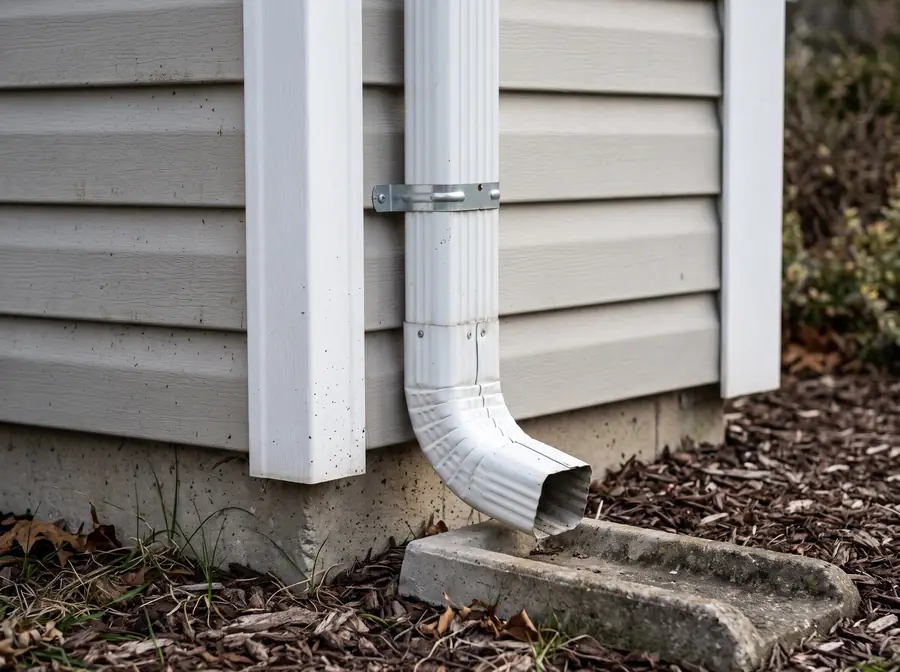
With straps or brackets into the wall at the top, middle and bottom, and with elbows crimped and screwed so they do not pull apart. On two-storey walls, more straps hold against wind. Downspouts that discharge to the ground should end in an elbow and extension, not dump straight down beside the foundation.
Can a downspout feed a rain barrel?
Yes, with a diverter or by running the downspout into the barrel, plus an overflow that drains safely. A long autumn rain will fill a barrel quickly, so the overflow does most of the work in winter. Managing rain on site in Portland may also qualify for a Clean River Rewards discount.
What goes wrong with downspouts?
Jammed elbows, crushed bases, joints pulled apart, extensions knocked aside and underground lines that back up. See downspout repair.
How should a downspout be routed on a hillside lot?
Carefully. On slopes over 10 percent, Portland's guidance says not to disconnect downspouts to the yard, because water can saturate soil and run toward neighbors. On sloped lots, keeping an existing connection, or using an engineered system with a permit, is usually safer. Ask the contractor and the city before changing drainage on a hillside.
What about downspouts near driveways and paths?
Extensions should not cross walkways, patios or driveways, where they become trip hazards and can be crushed. Route downspouts to the side of a path, or use a hinged extension that flips up for access.
What does a downspout cost?
Each downspout adds material and labor; 3x4 costs a little more than 2x3, and round copper the most. Extensions, splash blocks and disconnection work add a little more. Ask for downspouts to be itemized on the quote.