
On this page
- What makes a gutter seamless?
- Why do joints matter in Portland?
- How are seamless gutters hung?
- Which profiles and sizes are available?
- What metals can be formed seamless?
- What do seamless gutters cost?
- What should you check on the day?
- When does sectional still make sense?
- Can seamless gutters be installed in winter?
- How do you choose between 5-inch and 6-inch seamless?
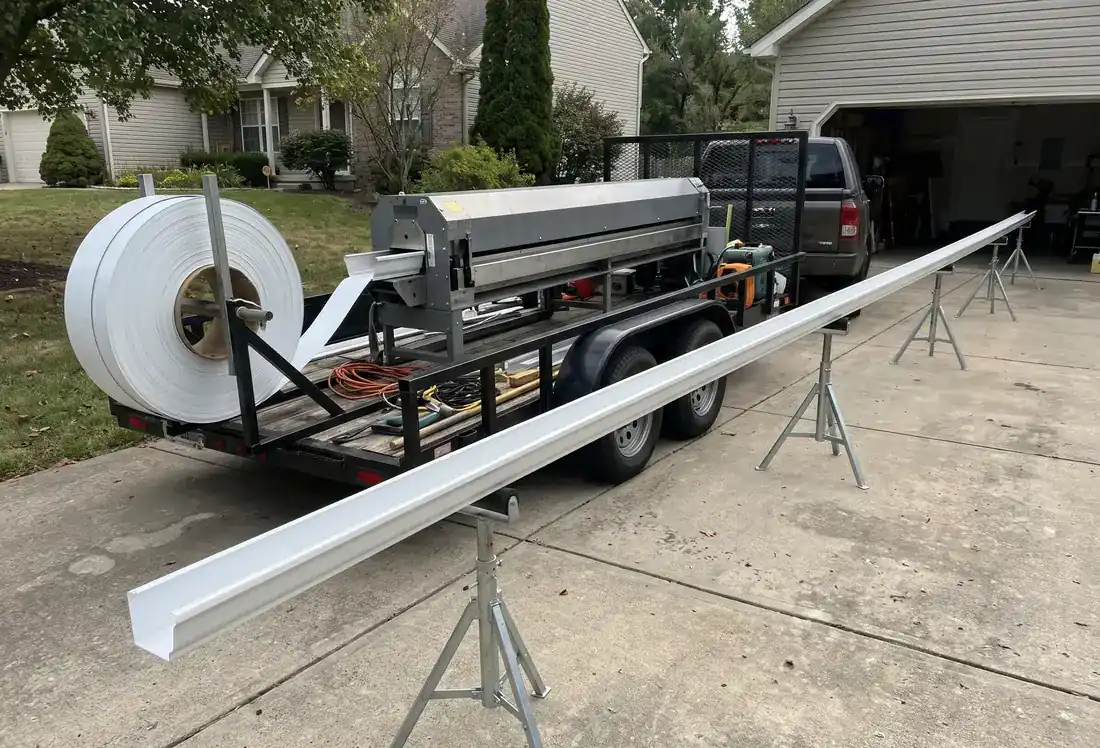
What makes a gutter seamless?
It is formed at the house. A contractor brings a roll-forming machine and a coil of flat metal, measures each run, and feeds the coil through the machine to make one continuous length of gutter for that run. The only joints are at corners, end caps and outlets. Sectional gutters, by contrast, come in fixed lengths joined every 10 feet or so. Call
to talk to a contractor who installs seamless gutters around Portland.| Seamless | Sectional | |
|---|---|---|
| Made | On site from coil | Factory lengths |
| Joints on a 40-foot run | None along the run | Three or four connectors |
| Leak points | Corners, ends, outlets | The same plus every seam |
| Look | Unbroken line | Visible joints |
| Upkeep | Occasional corner reseal | Regular seam reseals |
Why do joints matter in Portland?
Because a joint here faces months of water and wet debris, not a few storms. Portland's airport records measurable rain on about 157 days a year, and much of it falls from October to May when gutters are also holding needles, seeds and moss. Every seam is a bead of sealant that has to stay bonded while wet debris sits against it. Fewer seams means fewer joints to fail over that long season, and fewer ladder trips to reseal them.
How are seamless gutters hung?
On screw-in hidden hangers driven into sound fascia or rafter tails, usually about every 24 inches and closer under heavy trees. Each run is pitched toward its outlets, typically about a quarter inch over 10 feet, enough to drain without looking crooked. Long runs pitch both ways from the middle to outlets at each end. Corners are mitered, riveted and sealed; end caps crimped and sealed; outlets cut and fitted with drop outlets for the downspouts.
Which profiles and sizes are available?
| Profile | Common sizes | Best for |
|---|---|---|
| K-style | 5-inch, 6-inch | Most houses |
| Half-round | 5-inch, 6-inch | Older and period homes |
| Fascia or box style | Varies | Some modern and commercial buildings |
Size depends on roof area, valleys and trees. At the City of Portland's design intensity of 2.86 inches an hour, a 5-inch K-style run handles about 1,755 square feet of roof at a 6/12 pitch and a 6-inch about 2,530, using the This Old House method. See 6-inch gutters.
What metals can be formed seamless?
| Metal | Notes |
|---|---|
| Aluminum | Most common; .027 or .032 inch; many colors |
| Steel (galvanized or Galvalume) | Heavier, stiffer; some contractors form it |
| Copper | Formed by specialists; often installed in soldered lengths |
See aluminum gutters and copper gutters.
What do seamless gutters cost?
National guides put installed seamless aluminum at about $9 to $14 a foot for 5-inch and $11 to $17 for 6-inch, according to the Angi aluminum gutter cost guide and the This Old House seamless gutter cost guide. Those are national figures, not Portland quotes. Corners, downspouts, second storeys, fascia repair and guards all add to a job. See the cost guide.
What should you check on the day?
- Each run is one piece from corner to corner or end to end.
- Hangers are hidden and screwed, not spikes through the face.
- Pitch is toward outlets, with no standing water when tested.
- Corners are riveted and sealed neatly, with no gaps.
- The drip edge laps into the gutter, so water cannot run behind it.
- Downspouts drain where agreed, with extensions in place.
- Debris is cleaned up, including metal shavings on the roof.
When does sectional still make sense?
Sheds, small outbuildings and very short runs, matching an existing sectional system on a small repair, and some copper and half-round profiles joined by soldering rather than sealant. For a house, seamless is the usual choice.
Can seamless gutters be installed in winter?
Yes, between storms. Forming and hanging work in cool weather, but sealant needs clean, dry metal to bond, so contractors schedule sealing in dry spells. Booking in late summer or early autumn avoids the wait.
How do you choose between 5-inch and 6-inch seamless?
By roof area, valleys and trees. Five-inch handles many single planes at Portland's design intensity; six-inch suits valleys, big planes and runs under firs and maples. See 5-inch vs 6-inch gutters.